---
title: "Aklamio's Cookie Setup"
url: "https://docs.aklamio.com/en/article/aklamios-cookie-setup"
language: "en"
last_updated: "2026-10-02T11:03:23.979Z"
---
# Aklamio's Cookie Setup
#### Why does Aklamio use cookies?
Aklamio offers customer incentive programs & more specifically the most widely used product amongst Aklamios B2B customers is the referral program. On the latter cookies are utilized to guarantee the functionality.
To make that clear let’s look to understand how that works from a technical point of view.
A user will sign up in Aklamio’s platform by creating a user-account using their email-address. To this email-address a reward is later assigned for the respective incentive action. In the referral case a matching between that “referrer” account to the purchase needs to be made. The information needed that links these is stored in a cookie.
Hence it is essential that a proper cookie policy is accounted for.
#### Why does Aklamio use cookies?
Aklamio's Cookie Setup
**Please list Aklamio's tracking cookie** **`TrackingID`** **and your own first-party referral ID cookie under "Strictly necessary" in your consent tool.** If they sit in any other category, every visitor who rejects or ignores your cookie banner loses their referral link, and the referrer never receives their reward.
In short, we ask you to:
1. Put the Aklamio tracking cookies in the table below in your **Strictly necessary** group.
2. Make sure the Aklamio script (`api.aklamio.com/assets/embed/…`) is **not blocked** by your consent tool or tag manager before consent is given.
3. Remove the legacy Aklamio cookies we no longer use (Hotjar, VWO, `shop_country`, `locale`).
4. Test a referral journey with **all optional cookies rejected** before go-live.
Other cookies set on the Aklamio-hosted referral portal are covered by Aklamio's own consent banner. You don't need to classify them as strictly necessary.
## How referral attribution works
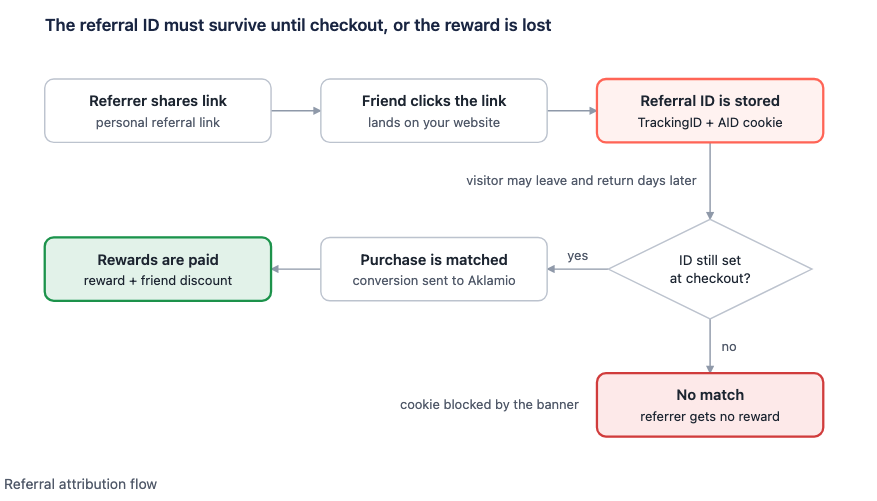
A referral is only rewarded if the referral ID stored at the first click is still there when the friend buys.
The referral ID must survive until checkout, or the reward is lostReferrer shares linkpersonal referral linkFriend clicks the linklands on your websiteReferral ID is storedTrackingID + AID cookievisitor may leave and return days laterID still setat checkout?yesnoPurchase is matchedconversion sent to AklamioRewards are paidreward + friend discountNo matchreferrer gets no rewardcookie blocked by the banner
Referral attribution flow
When the friend clicks a referral link, Aklamio sets `TrackingID` and passes a referral ID (the Aklamio AID) to your site. At checkout, the Aklamio pixel or your server-side integration sends the conversion with that ID, and the referrer is rewarded. If a consent banner blocked the cookie, the ID is gone and the purchase can't be matched.
## Why tracking cookies belong in "Strictly necessary"
The referral reward is a service the visitor asked for: they clicked a referral link to get a discount, and their friend expects a reward for it. Storing the referral ID is the only way to deliver that service, so it qualifies for the consent exemption for strictly necessary storage.
The exemption comes from the ePrivacy rules, not the GDPR:
| Market | Rule | Exemption |
| --- | --- | --- |
| EU | ePrivacy Directive 2002/58/EC, Art. 5(3) | Storage "strictly necessary" to provide a service explicitly requested by the user |
| Germany | TDDDG § 25(2) No. 2 | Same exemption, German implementation |
| UK | PECR, Regulation 6(4)(b) | Same exemption, UK implementation |
Aklamio's tracking cookies are built to stay inside that exemption:
- **One purpose only:** they hold a pseudonymous referral ID that links a purchase to the referral link used. No advertising, profiling or cross-site tracking.
- **No personal data in the cookie:** it holds a random ID, not a name or email address.
- **Short lifetime:** `TrackingID` expires after about 60 days, matching the referral attribution window.
Why a session cookie is not enough: a session cookie is deleted when the browser closes. Many referred customers compare offers and come back days later to buy. The referral ID has to survive that gap, so it must be a persistent cookie, and persistent cookies outside "Strictly necessary" are blocked until the visitor opts in.
Note: this is Aklamio's assessment, not legal advice. Your data protection officer makes the final classification for your website.
## Cookies to list as "Strictly necessary"
Add these entries to your cookie list. You can copy the descriptions as they are.
| Cookie | Host | Duration | Party | Category | Description (copy-ready) |
| --- | --- | --- | --- | --- | --- |
| `TrackingID` | .aklamio.com | 60 days | Third party | Strictly necessary | Set by our referral partner Aklamio when you arrive through a referral link. It stores a random ID so that your order can be matched to the referral and the referral reward or discount can be paid out. Not used for advertising or profiling. |
| Your referral ID cookie, e.g.
`aklamio_aid`
(name set by you) | your domain | Up to 60 days | First party | Strictly necessary | Stores the referral ID (Aklamio AID) from the referral link until checkout, so the order can be reported to our referral partner Aklamio and the referral reward can be paid out. |
The second row only applies if you pass conversions to Aklamio server-side (from your CRM, shop or order system to the Aklamio API). In that setup you store the `aid` URL parameter yourself, usually in a first-party cookie. It needs the same classification: if it is blocked, the AID is missing from the conversion and the reward cannot be assigned.
If your consent tool groups cookies by vendor, create a vendor "Aklamio GmbH (referral programme)" in the Strictly necessary group and attach the domains `aklamio.com`, `api.aklamio.com` and `analytics.aklamio.com`.
## Cookies on the Aklamio-hosted referral portal
The referral portal (`js.aklamio.com`, often embedded on your site as a widget or overlay) runs under Aklamio's own consent banner, CookieHub. You don't need to put these in your Strictly necessary group. You may list them for transparency in the category shown.
| Cookie / storage | Host | Duration | Category | Purpose |
| --- | --- | --- | --- | --- |
| `TrackingID` | .aklamio.com | 60 days | Strictly necessary | Referral attribution (see above) |
| `cookiehub` | .aklamio.com | 1 year | Strictly necessary | Stores the visitor's cookie consent choices for Aklamio |
| Google reCAPTCHA | google.com | Varies | Strictly necessary (security) | Protects sign-up and sharing forms against bots and fraud |
| `mp_…_mixpanel`
\+ browser storage | .aklamio.com | 1 year | Performance | Product analytics (Mixpanel) on how the portal is used |
| Sentry (browser storage, no cookie) | sentry-web.aklamio.com | Session | Strictly necessary / Performance | Error monitoring and session replay to fix technical problems |
## Legacy cookies you can remove
Earlier versions of this article listed these cookies. Aklamio no longer sets them, so please remove them from your cookie list. Leaving them in place makes your list less accurate, and it puts analytics tools in the Strictly necessary group by mistake.
## Setup checklist for your consent tool
The steps are the same in OneTrust, Cookiebot, Usercentrics, CookieHub and similar tools.
- Add `TrackingID` (host `.aklamio.com`, 60 days) to the **Strictly necessary** group.
- Add your first-party referral ID cookie (if you use one) to the **Strictly necessary** group.
- Assign the Aklamio script and requests (`api.aklamio.com`, `analytics.aklamio.com`, `js.aklamio.com`) to Strictly necessary, so they are **not blocked** before consent. Check auto-blocking and script-blocking rules too.
- In your tag manager (Google Tag Manager, Adobe Launch, Tealium), fire the Aklamio tag on the strictly necessary or "always" trigger, not on a marketing-consent trigger.
- Remove the legacy cookies listed above.
- Re-run your consent tool's cookie scan and check the Aklamio entries were not moved to "Unclassified" or another group.
**Test before go-live:**
1. Open a private browser window and click a test referral link.
2. On the cookie banner, choose **Reject all**.
3. Check that `TrackingID` is present: browser developer tools → Application → Cookies → `aklamio.com`.
4. If you store the AID yourself, check that your first-party referral ID cookie is set.
5. Close the browser, open it again, and complete a test order.
6. Ask your Aklamio contact to confirm the test conversion was attributed.
## What goes wrong if the cookies are misclassified
If the tracking cookies sit under Functional, Performance or Targeting, they are only set after an opt-in. Every visitor who rejects or ignores the banner is then untracked.
- **Missed rewards:** the purchase can't be matched to the referrer, so they don't receive their reward and the new customer may not get their discount.
- **More support work:** referrers contact your customer service to claim missing rewards, and each claim has to be checked by hand.
- **Lower programme performance:** referrals look like they don't convert, and your reporting under-counts the programme's real results.
- **Lost trust:** a referrer who misses one reward is unlikely to recommend you again.
## References
- [ePrivacy Directive 2002/58/EC, Art. 5(3)](https://eur-lex.europa.eu/legal-content/EN/ALL/?uri=CELEX:32002L0058)
- [Article 29 Working Party, Opinion 04/2012 on Cookie Consent Exemption (WP194)](https://ec.europa.eu/justice/article-29/documentation/opinion-recommendation/files/2012/wp194_en.pdf)
- [EDPB Guidelines 2/2023 on the technical scope of Art. 5(3) ePrivacy Directive](https://www.edpb.europa.eu/our-work-tools/our-documents/guidelines/guidelines-22023-technical-scope-art-53-eprivacy-directive_en)
- [ICO: Cookies and similar technologies (PECR guidance, UK)](https://ico.org.uk/for-organisations/direct-marketing-and-privacy-and-electronic-communications/guide-to-pecr/cookies-and-similar-technologies/)
- [TDDDG § 25 (Germany)](https://www.gesetze-im-internet.de/ttdsg/__25.html)